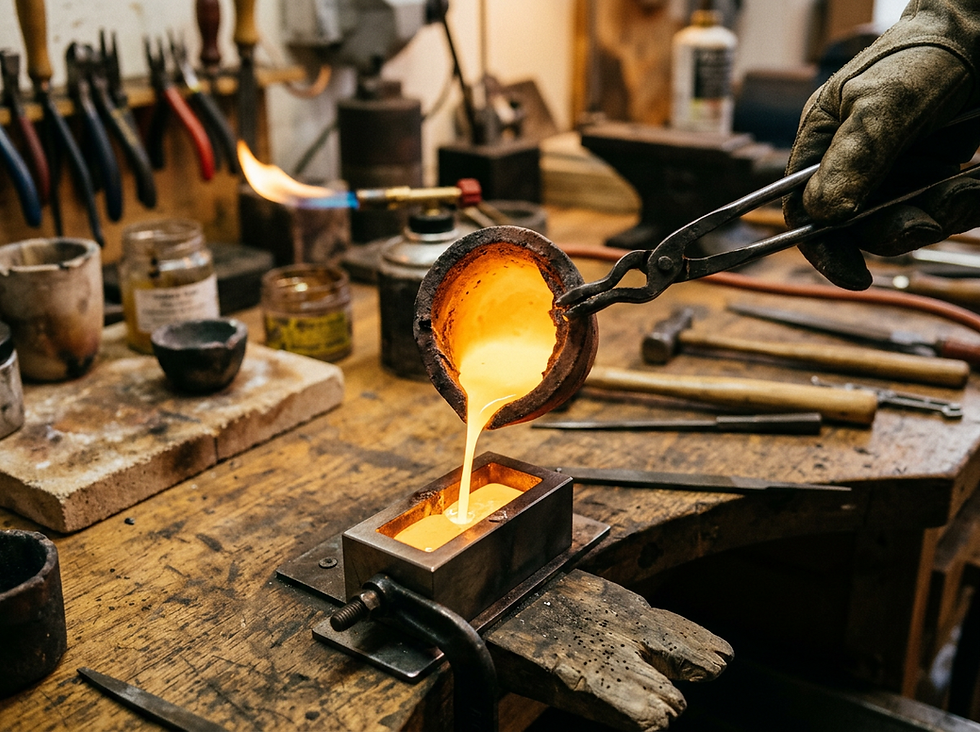
The Hand as Instrument in Modern Craftsmanship
IL MESTIERE · THE HOUSE LEDGER
Before a piece can be shaped, polished, or worn, there is a more fundamental decision: what material will carry the object into existence?
There are things a hand knows that a specification cannot fully describe. A drawing can define proportion. A measurement can set a limit. A machine can repeat a cut with impressive control. Yet an object does not become finished by instruction alone.
Every Dante Bianco piece begins with an idea. It may start as a drawing, a gemstone, a structural question, or a material that suggests a form before the form is fully known. But an idea is not yet an object.
Between the drawing and the finished piece lies a physical sequence: cutting, forming, filing, soldering, fitting, polishing, adjusting, and sometimes beginning again. This is where the work of the hand begins.
Handwork is often romanticized as a rejection of technology. That is not how we understand it. A modern atelier can use digital design, precise measurement, specialized tools, and advanced machinery while remaining dependent on human judgment. The true distinction is not between machine and hand. It is between automation and authorship.
The hand is not only a tool
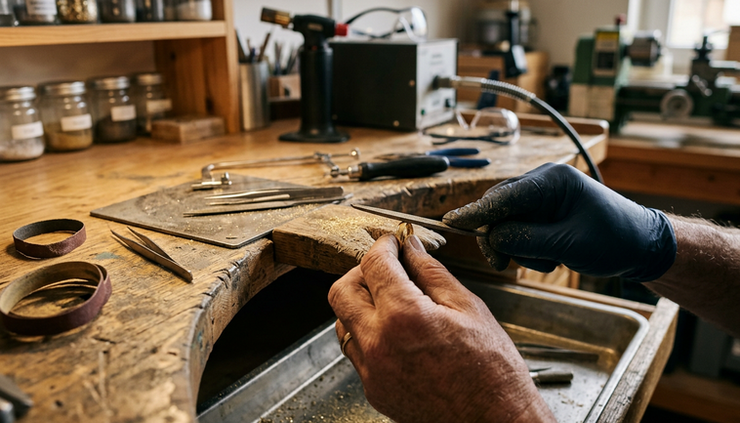
A hand can grip, press, turn, steady, and strike. In jewelry making, those actions matter. But the hand is not simply a tool that performs tasks. It is also an instrument of reading.
A maker feels tension through a file. The surface gives information long before the eye confirms it. A change in resistance can show that a curve has shifted, that a seam has thickened, or that a plane is no longer true. The hand senses whether a piece is balanced, whether a stone sits naturally in its seat, whether a clasp closes with the right amount of confidence.
This form of knowledge is not vague. It is physical and specific. It comes from repeated contact with metal, heat, stone, pressure, and scale.
A specification may say that an edge should be softened. The hand decides how soft is enough. A drawing may indicate a profile. The hand discovers whether that profile still holds when the object gains weight, depth, and surface.
That is why handmade jewelry craftsmanship cannot be reduced to visible irregularity or nostalgia. It is not valuable because it looks primitive. It is valuable because it carries decisions made at close range.
Precision belongs inside handwork
Precision is often mistaken for the opposite of handwork. In reality, serious handwork depends on precision.
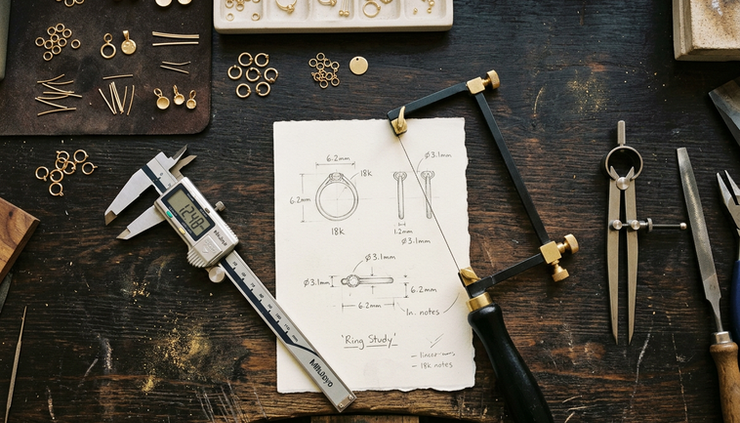
An atelier works with tolerances that are small enough to affect comfort, durability, and appearance. A fraction of a millimeter can change how a stone sits, how a ring feels between the fingers, or how light moves across a surface. Measurement matters because the object must function as well as it pleases the eye.
Machines can help. They can cut accurately, measure consistently, and provide clean starting points. Digital tools can test proportion, model structure, and reduce unnecessary waste. These capabilities do not diminish craftsmanship when they are used with discipline. They give the maker clearer conditions in which to make better decisions.
The problem begins when precision is treated as completion. A precisely cut part is not automatically a resolved object. It must still be fitted, judged, finished, and understood in relation to the whole.
At Dante Bianco, machinery, measurement, and digital tools are not treated as opposites to craftsmanship. They are instruments within it. Technology is used where it increases control. The maker’s eye and hand remain essential where material, proportion, and form require interpretation.
The machine can repeat a movement. The maker must decide whether the movement was worth repeating.
Material resistance shapes the final object
Materials do not simply obey. Gold, platinum, silver, gemstones, and alloys each carry their own limits and behaviors. They bend differently. They heat differently. They polish differently. They accept force in different ways.
A design may begin with a clean line on paper, but metal has memory. It may spring back after forming. A setting may require more support than a drawing first suggests. A stone may ask for a different relationship with light once it is held in the hand rather than imagined from above.
This resistance is not a flaw in the process. It is part of the process.
The maker listens to what the material allows and what it refuses. Some choices become clearer only during fabrication. A curve may need to be slightly eased. A thickness may need to be refined. A surface may need less polish, not more, because too much reflection can flatten the form.
This is one reason the work cannot be fully settled at the design stage. The object changes as it becomes real.
Repetition creates judgment
Repetition is often described as routine. In craft, it is more demanding than that.
Filing a surface once teaches very little. Filing thousands of surfaces teaches pressure, rhythm, restraint, and recovery. Soldering once teaches heat. Soldering repeatedly teaches timing, cleanliness, preparation, and the exact moment before too much becomes too late.
The discipline of repetition is not mechanical. It trains judgment. The goal is not to make the maker act like a machine. The goal is to build enough familiarity that the maker can notice what has changed.
In the atelier, repetition shows itself in small acts:
Testing a fit before committing to the next step
Returning to a surface after the first polish reveals a hidden mark
Adjusting pressure to preserve an edge
Rechecking symmetry from several angles
Knowing when to stop removing material
These actions seem modest from the outside. They are the difference between an object that is merely produced and an object that feels resolved.
The vocabulary of the atelier reflects this range of work: Craftsmanship · Handwork · Hand Fabrication · Jewelry Making · Metalworking · Precision · Making Process · Atelier · In-House Making. Each term points to a different part of the same commitment.
The object can change the design
A design is a proposal. Making tests it.
When a piece passes from drawing to metal, it gains mass, tension, reflection, and feel. The distance between two lines becomes a surface. A profile becomes an edge against the skin. A setting becomes a point of protection. A clasp becomes a daily action.
This is where authorship matters. The maker must decide whether to follow the drawing exactly or honor the intention behind it by changing the object.
That decision requires humility. It means accepting that the first idea may not be the best final form. It also requires confidence, because changes made during fabrication must be deliberate. Adjustment is not improvisation without standards. It is editing through contact.
A ring may need a softer inside edge for comfort. A pendant may need a slight shift in weight so it hangs correctly. A stone setting may need to be opened differently so light can enter without weakening the structure. None of these decisions announces itself loudly. Yet each one changes the experience of the piece.
Small quantities protect attention
There is a reason some objects should not be made in large runs. Scale changes the nature of production. When the goal becomes volume, the process must reduce variation, shorten judgment, and remove pauses that do not serve speed.
Small-quantity making protects a different set of values. It allows time for inspection between stages. It keeps the maker close to the work. It gives each object enough attention to reveal what it needs.
This does not mean every step is slow. Speed can be a sign of skill when it comes from experience. The important question is whether the process leaves room for judgment.
In small quantities, the maker can respond to the particular object in front of them. The polish can be adjusted to the form. The fit can be checked by feel as well as measurement. The final surface can be judged in relation to light, not only to a checklist.
The result is not sameness. It is consistency with life inside it.

The trace of the maker is not a mistake
The trace of the hand is often misunderstood. It does not mean roughness, inconsistency, or visible error. It means the object has passed through human judgment at every critical point.
A well-made piece can be clean, precise, and refined while still carrying the presence of the maker. That presence may be felt in the way a surface meets an edge, how a curve turns without feeling stiff, or how a polished area stops before it erases the character of the form.
The trace is not always visible at first glance. Sometimes it appears only through use. A ring that feels balanced after hours of wear. A clasp that closes smoothly without feeling fragile. A stone setting that protects without looking heavy. These qualities come from decisions made by someone who understood the object as a physical thing, not just an image.
Modern craft does not need to display the hand loudly to prove it exists. The finest trace is often quiet.
Making is a form of editing
Writing and making share one discipline: removal.
A maker cuts away, files down, reduces, refines, and returns. The work is not only to add beauty. It is to remove what distracts from the form. Too much metal can make a piece heavy. Too much polish can remove depth. Too much detail can weaken proportion.
Editing requires standards. It also requires restraint.
The unfinished object often contains several possible finished objects. The maker’s task is to choose the one that belongs. That choice may involve keeping a slight fullness in a curve, sharpening a line, or leaving a surface quieter than expected.
This is why the final stages are so demanding. Near completion, every decision carries more consequence. A careless polish can soften an edge that took hours to shape. A small change in pressure can alter a seat. A hurried finish can make the whole object feel less certain.
The last steps are not cosmetic. They are structural to the experience of the piece.
The human scale of the object matters
Jewelry exists at an intimate scale. It is worn on the body, touched often, and seen from close distances. It must live with movement, skin, fabric, weather, and time.
This creates a different standard from objects viewed only from afar. A piece of jewelry must make sense under the eye and in the hand. It should feel considered from every angle, including the angles that only the wearer will know.
The human scale asks practical questions.
Does the ring turn comfortably? Does the edge catch? Does the pendant rest as intended? Does the earring carry its weight well? Does the object invite touch without feeling delicate in the wrong way?
These are not secondary concerns. They are central to the work. An object can be visually persuasive and still fail at the scale of use. The hand helps prevent that failure because it tests the object as a body will experience it.
What remains after the making
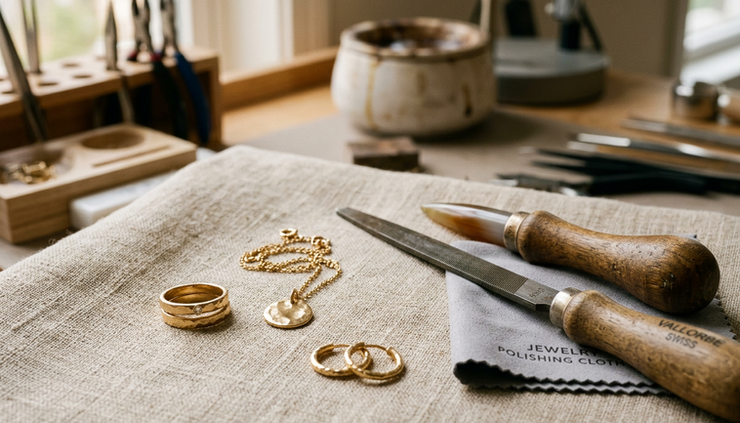
When an object leaves the atelier, much of the work becomes invisible. The cutting, soldering, fitting, filing, and adjusting recede into the finished form. The rest remains as proportion, comfort, surface, durability, and presence.
This is the quiet achievement of the hand as instrument. It does not ask to be admired apart from the object. It serves the object until the object feels whole.
Modern craftsmanship is not a retreat from precision or technology. It is the practice of placing tools under judgment. It accepts the help of machines without surrendering authorship to them. It uses measurement without confusing measurement for meaning. It respects the drawing while recognizing that the finished piece must answer to material, scale, and touch.
At Dante Bianco, the work of the hand begins beyond the drawing. It continues through resistance, repetition, correction, and restraint. What remains is not only a made object, but a record of attention.
The most enduring pieces carry that attention quietly. They do not announce every decision. They simply feel as if nothing essential has been left unresolved.
From the Atelier
At Dante Bianco, machinery, measurement, and digital tools are not treated as opposites to craftsmanship.
They are instruments within it.
The House uses technology where it increases precision and control, and relies on the maker's judgment where material, proportion, and form require interpretation.
The machine can repeat a movement.The maker must decide whether the movement was worth repeating.
Continue your correspondence with the House.
The Ledger explores the materials, techniques, stones, and ideas behind the objects of Dante Bianco.