What Makes a Gemstone Exceptional?
Updated: Oct 4
THE STONE · THE HOUSE LEDGER
An exploration of color, light, character, and the decisions that reveal a stone's fullest expression.
Not every remarkable stone is large. Not every valuable stone is beautiful. And not every beautiful stone reveals itself immediately.
At the House, we look at a gemstone as more than a quantity of material.
We look at how it holds light.
How its color moves through the stone.
How its proportions create depth.
How its internal character changes what the eye sees.
And, ultimately, whether the stone possesses something that makes you want to keep looking.

A gemstone is not merely a colored object.
It is an optical structure.
BEYOND CARAT
Carat is easy to measure.
Exceptionalness is not.
A larger gemstone naturally commands attention, but size alone tells us very little about the experience of the stone. Two stones of identical weight can behave completely differently in the hand and under light.
One may appear flat.
Another may seem to contain its own light.
One may have beautiful color but little life.
Another may reveal changing tones as it moves.
This is where the evaluation of a gemstone becomes less like measuring an object and more like studying one.
At the House, we consider four qualities especially closely:
COLOR. LIGHT. CHARACTER. CUT.
They are not independent.
They interact.
A particular color may become extraordinary because of the way a cut distributes light through the material. An inclusion may diminish clarity in one stone while giving another its individuality. A proportion that works beautifully in one rough crystal may be completely wrong for another.
The stone has to be understood as a whole.

COLOR
Color is often the first thing we notice.
It is also one of the easiest things to oversimplify.
A gemstone's color is not simply a matter of being "blue," "pink," "green," or "red." We look at hue, tone, saturation, distribution, and how those qualities behave throughout the stone.
Does the color remain concentrated?
Does it become lighter toward the edges?
Does the stone show flashes of another hue?
Does its apparent color change when the stone moves?
Some stones possess a remarkable stillness of color. Others are almost restless.
Neither is inherently better.
The question is whether the color possesses character—and whether the cut allows that character to be seen.

LIGHT
A gemstone does not simply possess color.
It interacts with light.
This is where a stone can become genuinely compelling.
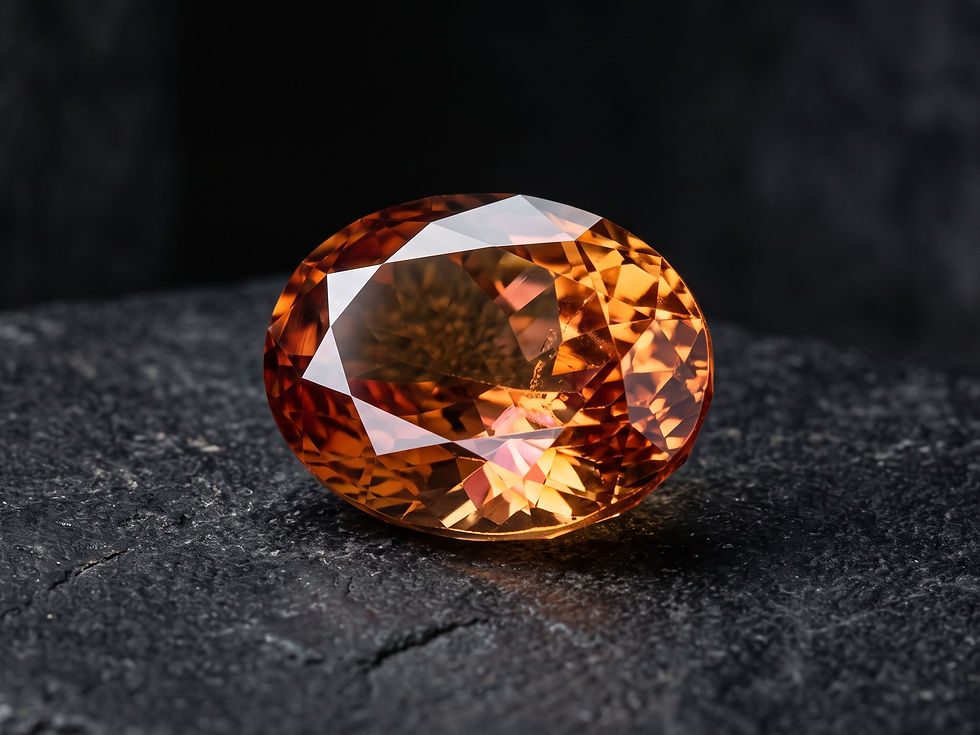
Light enters through the crown, travels through the material, encounters facets and internal features, and returns to the eye in a constantly changing arrangement of brightness, reflection, dispersion, and shadow.
The result is what makes a gemstone feel alive.
A stone with excellent color but poor optical behavior can appear dull.
A stone with extraordinary optical performance can continue revealing itself long after the initial impression has passed.
This is one reason we are interested in gemstones as volumes rather than surfaces.
The experience does not exist only on the face of the stone.
It exists throughout it.

CHARACTER
Perfection is not always the goal.
Some of the most memorable gemstones possess something that cannot be reduced to a specification sheet.
A particular inclusion.
A subtle veil.
A tiny internal landscape.
A shift in tone.
A phenomenon that appears only from one direction.
These characteristics can become part of the identity of the stone.
This is especially important when selecting natural material.
Nature does not produce identical objects.
Every crystal develops through its own history of chemistry, pressure, heat, time, and geological circumstance. What appears inside the finished gemstone is, in a very literal sense, part of that history.
We do not automatically seek to erase every trace of it.
We ask what the stone is telling us.
And whether the cut can reveal it without compromising the integrity of the material.

THE CUT
The cut is where the conversation changes.
Before a gemstone becomes a finished object, it is potential.
The rough crystal contains possibilities—but it does not tell us automatically which one should be chosen.
The cutter has to decide.
Where should the table sit?
How much weight should be retained?
Which direction should the color face?
Where should the stone be opened to light?
Which internal features should be concealed, emphasized, or allowed to remain part of the composition?
Every facet is a decision.
And every decision changes what comes next.
This is why cutting is not simply a finishing process.
It is an act of interpretation.

THE CUT IS A SERIES OF DECISIONS
This is one of the reasons we cut stones by hand at Dante Bianco.
Our faceting work is performed on a Mast faceting machine, specifically an Ultra Tec V2, which provides the precision necessary to control angles, indexing, depth, and symmetry.
But the machine does not decide what the stone should become.
The cutter does.
The machine provides control.
The eye provides judgment.
The material provides the constraints.
A gemstone can be perfectly symmetrical and still fail to be interesting.
A technically complex cut can still be wrong for the rough.
The objective is not complexity for its own sake.
It is correspondence.
The proportions, facets, color, material, and optical behavior should belong to one another.

THE SPECIMEN
Every exceptional stone deserves to be understood on its own terms.
Rather than reducing a gemstone to a photograph and a price, we record the material itself: its species, origin when known, weight, dimensions, treatment, cut, and other characteristics relevant to understanding the stone.
These details do not replace looking.
They make looking more meaningful.
A photograph tells you what the stone looks like in one moment.
The specifications tell you what the object is.
The experience of the gemstone comes from bringing those two things together

WHAT MAKES A STONE WORTH KEEPING?
Ultimately, exceptionalness is not a single number.
It is an accumulation of qualities.
Color that stops the eye.
Light that changes with movement.
Character that rewards closer inspection.
A cut that makes the material more itself.
And sometimes something less measurable:
the feeling that the stone has a presence of its own.
This is the standard we pursue when selecting material for the House.
Not simply stones that satisfy a specification.
Stones that reward attention.
Because the most interesting gemstones are rarely exhausted by their first impression.
They become better the longer you look.
A NOTE FROM THE HOUSE
We believe a gemstone should reward attention.
The first glance should create curiosity.
The second should reveal structure.
The third should reveal something you did not notice before.
That is the beginning of collecting.
And, perhaps, the beginning of taste.
THE HOUSE OF DANTE BIANCO
Where poetry meets metallurgy. Where legacy is forged, not announced.

Continue your correspondence with the House.
The Ledger explores the stones, materials, techniques, and ideas shaping the objects of Dante Bianco.
