A Stone With Two Faces: The Hidden World of Gemstone Fluorescence
THE STONE · THE HOUSE LEDGER
Some gemstones reveal their character only when the conditions of observation change.
A gemstone can appear calm in daylight and become vivid under ultraviolet light. That second appearance is not a trick of the lamp. It is a material response, shaped by chemistry, structure, and the conditions of observation.
Under ordinary light, a stone shows familiar qualities: body color, transparency, brilliance, luster, and the way its cut returns light to the eye. Move it toward a window, place it beneath a warm lamp, or rotate it in the hand, and its character shifts. Light enters, crosses the stone, reflects, scatters, and returns.
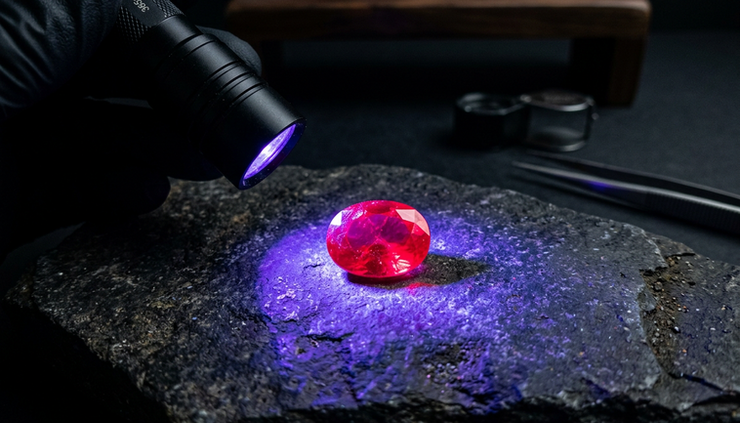
Some stones do something more. When exposed to ultraviolet radiation, they absorb energy that the eye cannot see and emit visible light in return. This effect, known as fluorescence, can reveal a hidden glow that exists alongside the visible face of the stone.
The other light inside a gemstone
A gemstone is never fully separate from the light that reveals it. Color itself is a relationship between material and illumination. Fluorescence adds another layer to that relationship because the stone becomes an active participant in the visual event.
In simple terms, ultraviolet light carries energy beyond the violet end of the visible spectrum. Human eyes do not perceive UV light directly. Certain materials absorb that invisible energy, then release part of it as visible light. The emitted light may appear blue, red, orange, green, yellow, or white, depending on the stone.
This response can be faint, moderate, or strong. It may appear evenly across the stone, or it may reveal zones, growth structures, inclusions, or areas that respond differently.
The visible glow is not simply a reflection of the ultraviolet source. It comes from within the material. That is what makes fluorescence so useful, and so visually compelling. It shows that a stone may hold more information than daylight alone can disclose.
How ultraviolet light creates visible glow
Fluorescence begins when a gemstone absorbs ultraviolet energy. That energy excites electrons within the material. As those electrons return to a lower-energy state, they release energy as visible light.
The nature of that visible light depends on several factors:
The stone’s chemical composition
Trace elements present in the material
Defects or irregularities in the crystal structure
The wavelength of the ultraviolet light
The strength and angle of the UV source
The surrounding lighting conditions
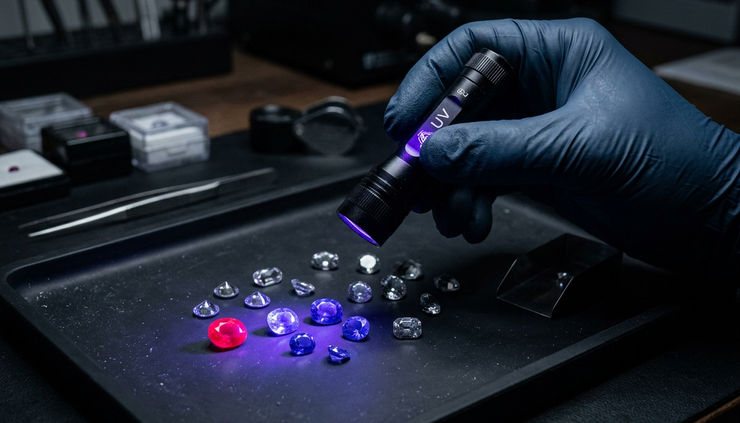
Gemologists often distinguish between longwave UV and shortwave UV. Longwave UV is commonly associated with lamps around 365 nanometers. Shortwave UV is commonly associated with lamps around 254 nanometers. A stone may react to one and not the other, or it may respond differently to each.
Observation factor | Why it matters |
Longwave UV | Often used for initial gemstone observation and common testing setups |
Shortwave UV | Can produce different reactions, but requires more caution because it is more hazardous |
Dark viewing conditions | Make weak fluorescence easier to see |
Clean stone surface | Reduces confusing reflections, dust glow, or residue effects |
Known comparison stones | Help distinguish ordinary variation from diagnostic response |
Fluorescence is immediate while the UV source shines. If a glow continues after the light is turned off, that lingering effect is called phosphorescence. The two phenomena are related, but they are not the same.
What fluorescence can reveal
Fluorescence does not identify every gemstone on its own. It is one observation among many. Still, it can provide useful clues about a stone’s nature, origin of color, treatment history, or internal structure.
A careful description of gemstone fluorescence may include:
The UV wavelength used
The color of the emitted light
The strength of the reaction
Whether the response is even or patchy
Whether the glow appears in the body of the stone, in inclusions, or on the surface
Whether the effect stops immediately after the lamp is removed
This kind of record belongs within broader gemstone study. In a collecting archive or house ledger, it may sit beside notes for Gemstones · Natural Gemstones · Gemology · Gemstone Quality · Stone Studies · Rare Gemstones, but the real value comes from precise observation rather than broad category labels.
It can support identification
Some materials have known fluorescence patterns. Fluorite, for example, is famous for its fluorescent response, and the word fluorescence itself comes from fluorite. Certain rubies can glow strongly red under UV light because of chromium. Some diamonds fluoresce blue, while others show little or no reaction.
These facts can guide examination, but they do not produce a complete identification. Similar-looking materials may show similar effects. Stones from different sources may behave differently. Treatments may also change the observed response.
Fluorescence narrows a question. It does not close the case.
It can reveal internal zoning
Some stones grow in stages. As chemical conditions change during formation, different zones may incorporate different trace elements or structural features. Under daylight, these zones may be subtle. Under UV light, they can become easier to see.
This is one reason fluorescence matters in stone studies. It can reveal patterns that relate to crystal growth, color distribution, or internal history. A stone that looks even in normal light may show bands, patches, or core-and-rim structures under ultraviolet inspection.
It can expose fillers or surface residues
Not every glow belongs to the gemstone itself. Oils, fillers, adhesives, coatings, polishing compounds, and dust can fluoresce. A bright line along a fracture or a glowing patch near the surface may point to a foreign substance rather than the natural body of the stone.
This makes interpretation more demanding. A glow is not automatically meaningful. The observer must ask where the fluorescence appears and whether it corresponds to the stone’s structure or to something added later.
Familiar stones with notable fluorescence
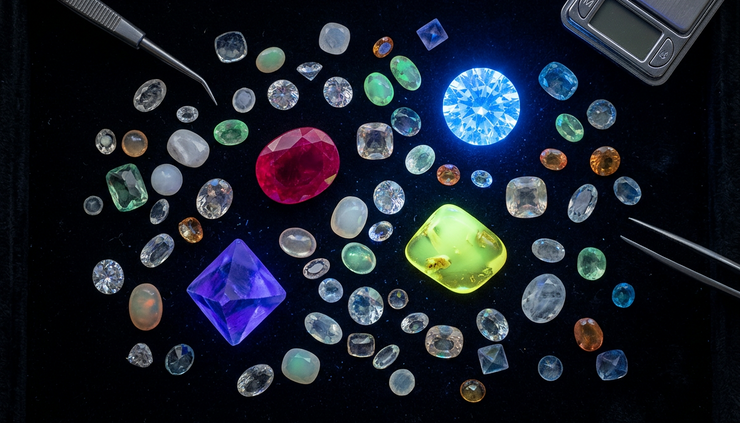
Fluorescence varies from stone to stone, even within the same gem variety. The examples below are common reference points, not fixed rules.
Diamond
Many diamonds show no visible fluorescence, while others fluoresce blue under longwave UV. Yellow, orange, green, and white reactions can also occur.
In diamond grading, fluorescence is usually described by strength, such as none, faint, medium, strong, or very strong. Its effect on appearance depends on the individual stone. In some diamonds, fluorescence has little visible impact in normal lighting. In others, strong fluorescence may influence perceived color or transparency.
The key is not the label alone. The important question is how the stone looks in the lighting conditions where it will actually be worn or studied.
Ruby and sapphire
Ruby often owes its red color to chromium, and chromium can produce strong red fluorescence. This glow can make some rubies appear more vivid under certain lighting.
Sapphire is more varied. Blue sapphire often shows weak fluorescence or none, though responses differ according to trace chemistry and origin. Fancy sapphires may produce other reactions. As with diamond, the observation is useful only when combined with other tests.
Emerald
Emerald may show weak to moderate red fluorescence in some cases, often related to chromium or vanadium. Yet emeralds also vary widely, and many show little obvious reaction.
For emerald, fluorescence can also raise questions about fracture filling. Some fillers or oils may respond under UV light, especially in fractures. This does not replace microscopic examination, but it can point the observer toward areas that deserve closer inspection.
Opal, amber, and fluorite
Opal may fluoresce in white, greenish, or other tones, depending on type and composition. Amber can show blue, yellow, or greenish responses, though reactions vary by source and condition. Fluorite is one of the classic fluorescent minerals, often glowing blue, violet, or other colors.
These materials show why fluorescence can be both scientific and beautiful. It is an observation method, but it also reveals a hidden visual world.
Why fluorescence does not equal quality
A glowing stone is not automatically better, rarer, or more valuable. Fluorescence can be desirable in some contexts and neutral or less desirable in others. Its meaning changes with the gem variety, the stone’s appearance in normal light, market preferences, and the expectations of the buyer or collector.
For colored stones, fluorescence may contribute to vividness, especially when the emitted light supports the body color. In ruby, red fluorescence can enhance the impression of vitality. In other stones, fluorescence may be weak, irrelevant, or visually distracting.
For diamonds, strong fluorescence can be a point of discussion, but it should not be judged in isolation. The stone’s cut, clarity, color, transparency, and overall appearance matter more than a single observation.
A useful question is simple: Does the fluorescence improve, reduce, or merely add information to the stone’s appearance?
That answer must come from direct viewing.
How to observe fluorescence responsibly
Ultraviolet examination should be controlled, careful, and safe. UV light can harm eyes and skin, especially shortwave UV. A casual glance with an unshielded lamp is poor practice.
Use these principles when observing stones under UV light:
Work in a darkened area, not in total confusion or clutter
Keep the stone clean and dry
Use proper UV eye protection
Avoid looking directly into the lamp
Identify whether the source is longwave or shortwave
Observe the reaction briefly, then return to normal light
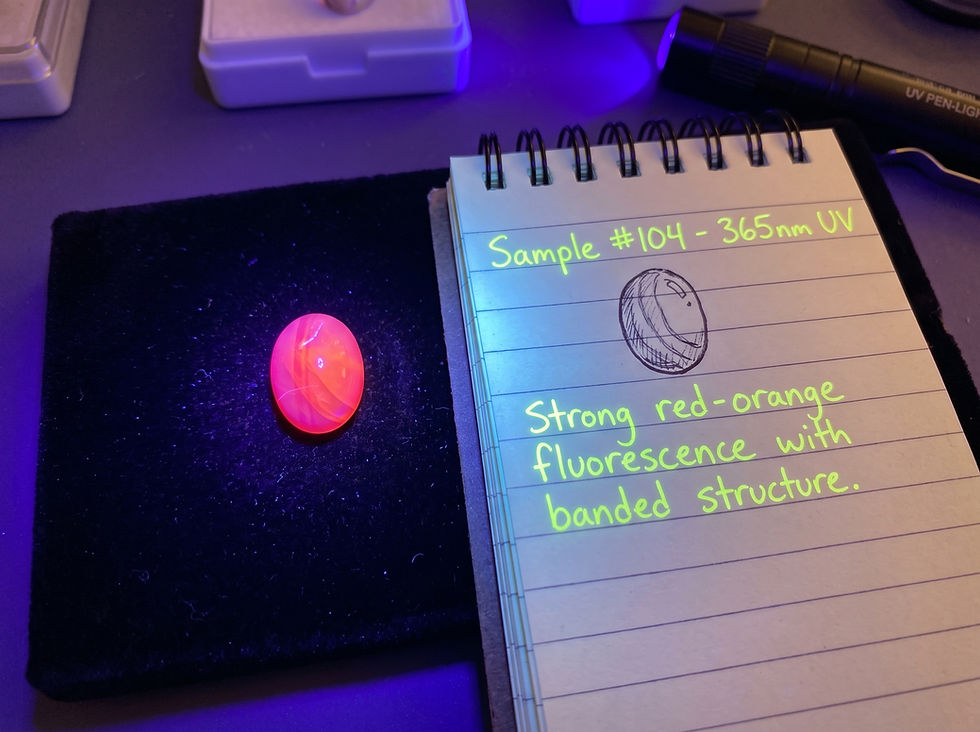
Record what is seen without exaggeration
A good note might read: “Moderate red fluorescence under longwave UV, uneven, stronger near pavilion side.” That description is more useful than “glows beautifully,” because it can be compared later.
The best observations also include normal lighting. A stone should be studied under daylight-equivalent light, incandescent or warm light where relevant, and ultraviolet light when appropriate. Each condition reveals a different part of the same object.
The hidden glow should be read with restraint
Fluorescence is one of the most compelling phenomena in gemology because it changes the terms of seeing. It reminds us that a gemstone is not a static object. It answers different kinds of light in different ways.
Yet restraint matters. A UV reaction can suggest, support, or complicate an interpretation. It should not carry more authority than it deserves. The glow may come from the gemstone, from an inclusion, from a filler, or from residue on the surface. It may be typical, unusual, diagnostic, or merely decorative.
The strongest practice is to treat fluorescence as part of a larger record. Observe the stone in ordinary light. Study its inclusions. Consider its cut, color, transparency, and known gemological behavior. Then add ultraviolet response to the ledger.
Some gemstones reveal their character only when the conditions of observation change. Fluorescence is one of those changes. It does not replace the visible face of a stone. It reveals another one.
Continue your correspondence with the House.
The Ledger explores the stones, materials, techniques, and ideas shaping the objects of Dante Bianco.

