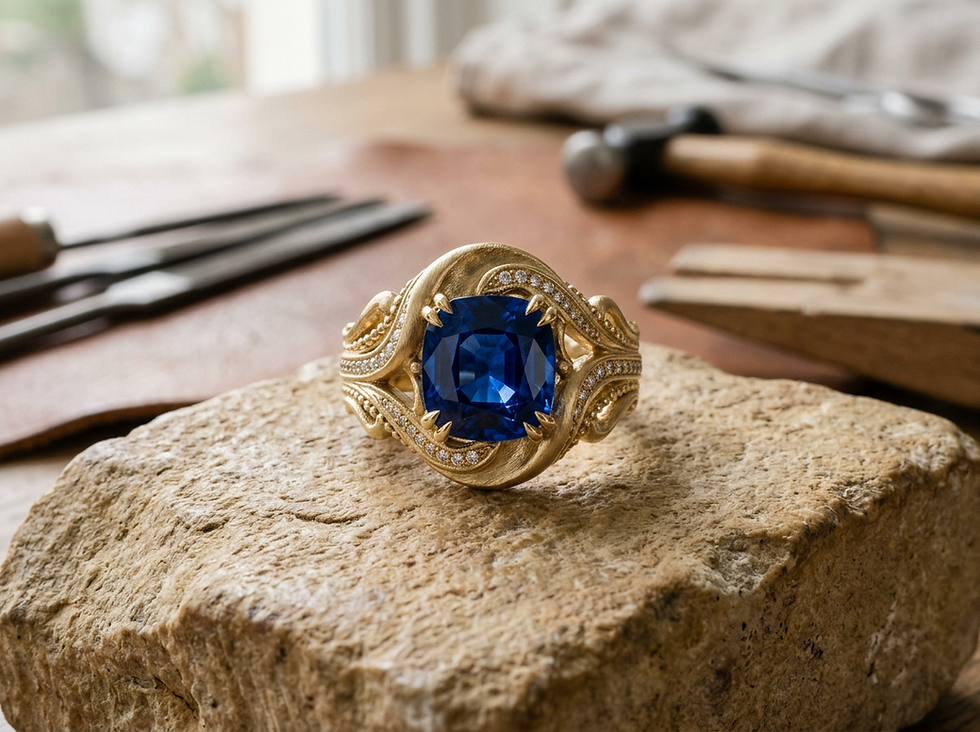
What Is Wearable Architecture
WEARABLE ARCHITECTURE · THE HOUSE LEDGER
Before a piece can be shaped, polished, or worn, there is a more fundamental decision: what material will carry the object into existence?
Jewelry can rest on the body, or it can change how the body is read. That difference is where architecture enters.
A ring may be small, but it still forms a boundary. A cuff may be light, but it still carries mass. A pendant may seem decorative, yet it can frame skin, hold shadow, and redirect light. These are not only ornamental choices. They are architectural choices made at the scale of the hand, the neck, the ear, and the wrist.
At Dante Bianco, wearable architecture begins with a simple idea: jewelry is not miniature architecture. It does not need tiny columns, arches, windows, or literal references to buildings. Instead, it can borrow architecture’s deeper discipline.
Structure. Proportion. Mass. Void. Balance. Tension. Material. Light.
A building organizes space around the human body. Jewelry organizes material around it. The scale changes, but the central questions remain. What should be present? What should be removed? How does light enter? Where does tension live? How does an object hold its own weight while remaining close to the body?

Jewelry Beyond Adornment
Jewelry has long been described through the language of decoration.
Precious metal. Gemstone. Surface. Color. Ornament.
These qualities matter. They are part of the pleasure of jewelry and part of its history. Gold has warmth. Platinum has density. A gemstone can hold color in a way no other material can. A polished surface can catch the eye from across a room.
But this language describes only part of what a piece can be.
Adornment tends to focus on what is added. Architecture also asks what is held back. It studies the relationship between weight and air, enclosure and openness, pressure and release. When this thinking enters jewelry design, the piece stops being only an object placed on the body. It becomes a structure that negotiates with the body.
A band can do more than circle a finger. It can create a line of compression, then open into relief. A necklace can do more than hang from the neck. It can distribute weight, create intervals, and use the collarbone as part of its composition. An earring can do more than sparkle. It can draw a line through space and change with every turn of the head.
This is the ground of architectural jewelry, where design depends as much on absence as on material.
The Space Between Matters
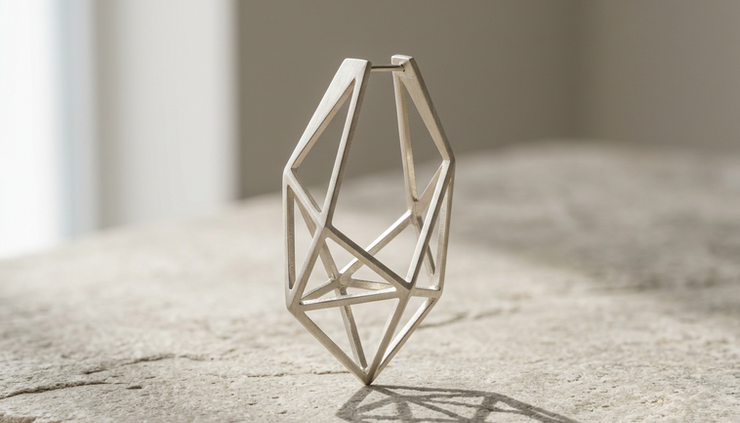
The most important part of a jewel is not always the metal or stone. Often, it is the space between them.
In architecture, space is not leftover. It is the point. Walls, ceilings, columns, and openings exist to shape experience. A courtyard is not empty because nothing fills it. It is active because it organizes movement, light, temperature, and attention.
Jewelry can work the same way.
The space between two planes of metal can create depth. The opening inside a ring can become a visual pause. The gap between a pendant and the skin can make the body visible through the object, rather than hidden beneath it.
This kind of work requires restraint. A designer must know when to stop adding. More detail can weaken a form. More surface can flatten it. More ornament can prevent the eye from understanding the structure.
The void is not an absence of design. It is a designed condition.
That is why negative space is not a decorative trick. It is one of the clearest signs that a piece has been composed rather than merely embellished. It gives the object breath. It allows the body to participate. It lets light pass through, and that passage changes the piece from every angle.
The Void as Structure
It may seem strange to call a void structural. A void, by definition, is where material is missing. Yet in both buildings and jewelry, the removed part often gives the remaining part its force.
An arch works because of the opening beneath it. A window changes a wall by interrupting it. A courtyard gives a building inward focus. A passageway directs the body before any sign tells it where to go.
In jewelry, the same principle appears in smaller but equally exact ways.
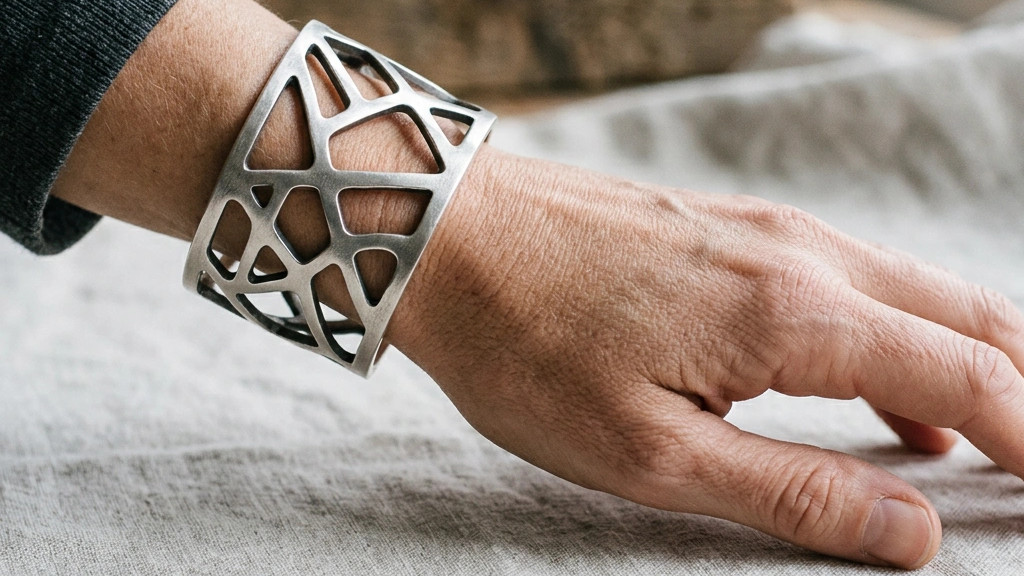
An open ring can feel stronger than a fully closed one if its edges carry tension. A cuff with a cutout can look more precise than a solid band if the opening clarifies the object’s geometry. A pendant made from two separated forms can feel complete because the eye bridges the space.
The structure is not only in what is there. It is also in what the viewer completes.
This is where design becomes disciplined. The void must be placed with intention. If it is too small, it reads as an accident. If it is too large, the piece may lose its stability or its relationship to the body. If it is poorly proportioned, the opening becomes a hole rather than a space.
A successful void carries pressure. It affects the edges around it. It changes the distribution of weight. It creates a relationship between object, air, and skin.

Framing Without Enclosing
Architecture often frames experience without fully enclosing it. A doorway frames a view. A canopy frames movement. A window frames light. None of these elements need to possess the space completely to define it.
Jewelry can frame the body in the same way.
A necklace may frame the hollow of the throat. A ring may frame the skin of the finger. An earring may frame the jawline or neck through motion. A bracelet may frame the wrist without closing it in.
This is a different kind of intimacy. The piece does not cover the body. It collaborates with it.
Framing requires a careful understanding of edges. Edges tell the eye where to look. They decide whether an opening feels severe, soft, quiet, or sharp. They also determine how the jewel behaves in motion. A thin edge may disappear in certain light. A thicker edge may hold a shadow and give the form more presence.
In this sense, the body is not a support for jewelry. It is part of the composition.
Skin becomes a background. Bone structure becomes a line. Movement becomes a changing viewpoint. The piece is never seen in a purely static state, because the body is never fully still. This is one reason architectural thinking belongs so naturally to jewelry. Both disciplines must account for human scale.
Light Through the Void
Light reveals structure. It also reveals weakness.
A form that looks strong in shadow may appear heavy in full light. A surface that seems clean from above may lose clarity when light hits it from the side. A void that looked dramatic in a sketch may disappear if its interior edges do not catch light.
This makes light one of the most demanding materials in jewelry.
Metal reflects. Stone refracts. Skin absorbs and warms the whole composition. Air, though invisible, allows light to move through the piece and create shadow. The relationship between these conditions decides whether a jewel feels alive or inert.
A polished interior edge can brighten a narrow opening. A matte plane can calm a reflective gemstone. A raised setting can let light pass beneath a stone, while a lower setting may make the gem feel more integrated with the structure.
The question is not simply whether a piece shines. The question is how it controls light.
Architectural jewelry often uses light as a way to expose the logic of the piece. An opening may cast a shadow that repeats the outer form. A gemstone may glow because material has been removed beneath it. A gap may create a fine line of brightness between two heavier masses.
Light turns the invisible design decision into visible experience.
Tension Between Solid and Void
Every architectural object carries tension. It may be physical tension, visual tension, or both.
In jewelry, the most compelling tension often appears between solid and void. A heavy form may be cut by a narrow opening. A broad surface may end suddenly in air. A gemstone may appear suspended because the setting holds it with almost severe restraint.
This tension gives the piece presence.
Without it, minimal jewelry can become plain. With too much of it, a piece can become theatrical or unstable. The work lies in finding the right degree of opposition.
A strong jewel may hold several tensions at once:
A dense metal form paired with a slim opening
A sharp edge softened by the curve of the body
A transparent stone set inside a solid frame
A polished surface placed next to a shadowed recess
A rigid geometry adjusted for comfort and wear
The best results feel inevitable. They do not announce how many decisions went into them. They simply sit with clarity.

Proportion Makes the Opening
An opening is only successful if its proportions are right.
Too narrow, and it becomes a slit. Too wide, and the surrounding form loses authority. Too centered, and it may feel predictable. Too far off balance, and it may feel unresolved.
Proportion is the discipline that gives absence its shape.
In small objects, proportion becomes even more unforgiving. A difference of a fraction of an inch can change how a ring looks on the hand. A slightly thicker wall can make a pendant feel grounded rather than fragile. A small shift in the placement of a stone can change the entire balance of a composition.
This is why architectural jewelry cannot rely only on concept. It must be tested through scale, weight, and wear.
A drawing may show the idea. A model shows whether the idea can live near the body. The wrist bends. The hand closes. The neck moves. Earrings respond to posture, hair, and motion. The piece must keep its formal clarity while adapting to these facts.
Proportion is not decoration. It is what lets the object remain itself while being worn.
The Gemstone as a Volume
A gemstone is often treated as the center of a piece. Architectural thinking changes that relationship.
Rather than seeing the gemstone only as a point of color or value, it can be understood as a volume. It has depth, mass, transparency, and orientation. It occupies space. It affects light. It changes the balance of the structure around it.
A gem can act like a wall of light. It can become a window, allowing the eye to move through color. It can read as a dense block if the cut and setting emphasize weight. It can also seem almost weightless if air and light pass around it.
This approach changes how settings are designed.
The setting no longer exists only to secure the stone. It becomes the architectural condition in which the stone is read. A bezel can act like a frame. Prongs can act like points of suspension. A recessed setting can make the gemstone feel embedded within mass. An elevated setting can make it feel lifted into light.
The gem is not simply placed on the jewel. It becomes part of the structure.
Negative Space and the Body
Negative space in jewelry is never empty once the piece is worn. The body completes it.
An open ring frames skin. A bracelet cutout reveals movement beneath the metal. A pendant opening may show fabric, collarbone, or shadow depending on how it is worn. The same void changes from one person to another and from one moment to the next.
This is why wearable objects have a quality buildings do not. The site moves.
Architecture responds to a place. Jewelry responds to a body in motion. It must consider comfort, pressure, orientation, friction, and scale. A piece may look resolved on a surface, then fail when worn if it ignores those conditions.
The body also gives meaning to absence. A void near the skin feels different from a void held away from it. A narrow gap can feel intimate. A large opening can feel bold and public. A hidden hollow may be known only to the wearer.
This relationship between seen and felt space gives architectural jewelry much of its depth.
The Discipline of Removal
Design often begins with addition. A line is drawn. A stone is selected. A volume is formed. But the final strength of a piece may come from removal.
Removal is not simplification for its own sake. It is a method of clarification.
What can be taken away without weakening the structure? What detail distracts from the essential form? Where does the eye need rest? Where should light enter? Where should the body appear?
These questions give the piece its discipline.
A jewel shaped by removal can feel quiet, but not empty. It can feel spare, but not thin. It can be minimal without becoming anonymous. The goal is not to erase character. The goal is to let the strongest relationships remain visible.
This is the architecture of absence. It asks the designer to trust space as much as material.
From Architecture to Jewelry
The influence of architecture on jewelry is not new.
Across history, jewelry has borrowed geometry, ornament, symbolism, and structural ideas from the built environment.
But imitation is not the objective here.
Dante Bianco is interested in what happens when architectural principles are translated rather than copied.
A building's cantilever does not need to become a miniature cantilever.
Its underlying idea - extension, balance, tension, support - can become a design principle.
A building's courtyard does not need to become a literal miniature courtyard.
Its principle of enclosed space around an absence can become a relationship between metal and gemstone.
The translation is conceptual.
The resulting object belongs to jewelry.
Wearability as a Constraint
Architecture can occupy enormous physical dimensions.
Jewelry cannot.
It must coexist with the body.
It must move with it.
It must remain wearable.
This constraint is not a limitation to overcome.
It is part of the design problem.
A structure that is visually compelling but uncomfortable has failed.
A gemstone that dominates the object but interferes with movement has failed.
A form that looks impressive from one angle but becomes awkward when worn has failed.
Wearability forces architecture to become intimate.
The monumental must become human-scaled.
The structural must become tactile.
The object must inhabit the body rather than merely sit upon it.
A Different Way of Looking
The word monument usually implies permanence and scale.
Jewelry possesses neither in the conventional sense.
Yet a piece can still have the psychological presence of a monument.
Mass can suggest permanence.
Proportion can create authority.
Material can create weight.
Structure can create order.
A gemstone can become a focal volume.
And the body provides the landscape upon which all of these relationships exist.
This is the idea behind wearable architecture at Dante Bianco.
Not miniature buildings.
Not architectural decoration.
Objects conceived with the discipline of architecture and experienced at the scale of the human body.
A Different Way of Looking
The purpose of this approach is ultimately not to make jewelry more complicated.
It is to make it more considered.
Instead of asking only whether a piece is beautiful, we can ask different questions.
Why is this element here?
What does this opening accomplish?
Why does the stone occupy this position?
What happens if the frame is incomplete?
Where does the weight of the object reside?
How does light move through it?
What happens when the wearer moves?
What can be removed without weakening the idea?
These questions turn jewelry from an arrangement of precious materials into an object of thought.
That is where architecture becomes useful.
The House Approach
At Dante Bianco, we call this Wearable Architecture because we believe jewelry can operate simultaneously as adornment, object, and structure.
The House begins with material and proportion, then considers structure, void, light, gemstone, and the body.
Ornament may emerge from those relationships.
It is not the starting point.
The objective is simple:
Do not make jewelry that merely looks expensive. Make objects that reward attention.
An object should reveal more when examined closely.
A surface should change with the light.
A void should become meaningful.
A gemstone should feel integrated into the architecture rather than placed inside it.
A structural decision should remain legible even after the object becomes familiar.
The result is jewelry that asks to be looked at twice.
And perhaps, eventually, to be looked at for a lifetime.
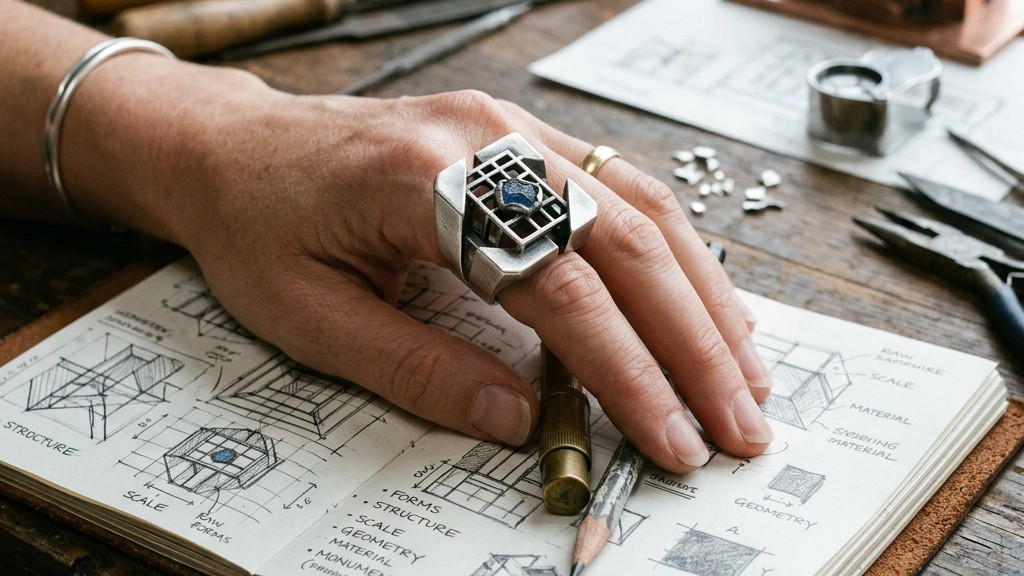
From the House
Wearable architecture is not a collection or a temporary aesthetic at Dante Bianco.
It is a way of designing.
It informs how we consider structure, proportion, material, gemstone, light, and the relationship between object and body.
The House is interested in what happens when those principles are taken seriously at the scale of jewelry.
Architecture gives us a language for space.
Jewelry gives us a way to carry it.
Continue your correspondence with the House.
The Ledger explores the stones, materials, techniques, and ideas shaping the objects of Dante Bianco.